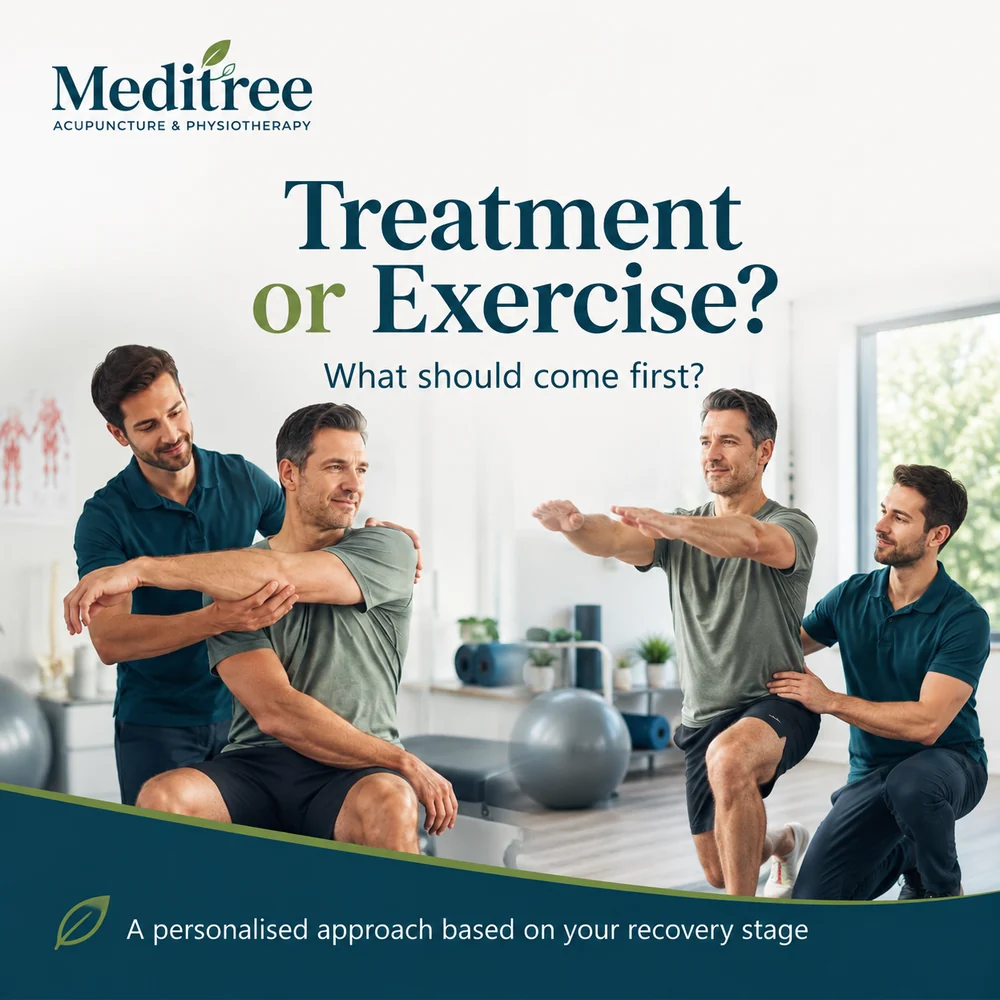
Quick answer
The key question is not which option is always better, but which approach is appropriate for your current pain, movement, strength and recovery goals. When pain severely limits movement, symptom management may need to come first. When movement is safe and manageable, exercise and rehabilitation may begin earlier.
Should I have acupuncture first?
Should I start exercising straight away?
Why does the pain return after treatment?
These are common questions we hear at Meditree Acupuncture & Physiotherapy.
Many people feel they must choose between treatment and exercise. In reality, the more useful question is not which option is universally better, but which approach best matches your current symptoms, movement, strength and recovery goals.
When pain is severe and movement is significantly restricted, symptom management may need to come first. When movement is safe and manageable, appropriate exercise and rehabilitation may begin earlier.
Some people need pain management first. Others can start rehabilitation from the beginning. In many cases, the two approaches can be combined and adjusted as recovery progresses.
Treatment can help create a more comfortable starting point for movement. Exercise can help turn that movement into function and confidence.
Key points
- When pain severely limits movement, pain management may need to come first.
- When movement is safe and manageable, exercise and rehabilitation may begin earlier.
- Less pain does not always mean strength and function have fully recovered.
- Exercise should begin at a manageable level and progress gradually.
- The order of treatment and exercise depends on your symptoms, movement and goals.
- A sudden increase in pain, new numbness or new weakness should be assessed before exercise is progressed.
Pain relief and functional recovery are not the same
When pain persists, people naturally use the painful area less. This may initially be a protective response, but over time it can contribute to reduced activity, loss of strength and flexibility, joint stiffness and changes in the way the body moves.
For this reason, reduced pain does not always mean the body has fully recovered.
Pain relief and functional recovery are connected, but they are not the same process.
What pain relief may involve
Pain relief focuses on making current symptoms and daily movement more manageable.
- Managing pain and muscle tension
- Reducing disruption to sleep and daily activities
- Helping movement feel more comfortable
- Creating a foundation for rehabilitation
What functional recovery may involve
Functional recovery focuses on rebuilding physical abilities that may have become weak or restricted.
- Restoring strength
- Improving joint movement
- Rebuilding balance and movement control
- Retraining movement patterns
- Returning to daily activities and work
- Preparing for sport or exercise
The role of pain management treatment
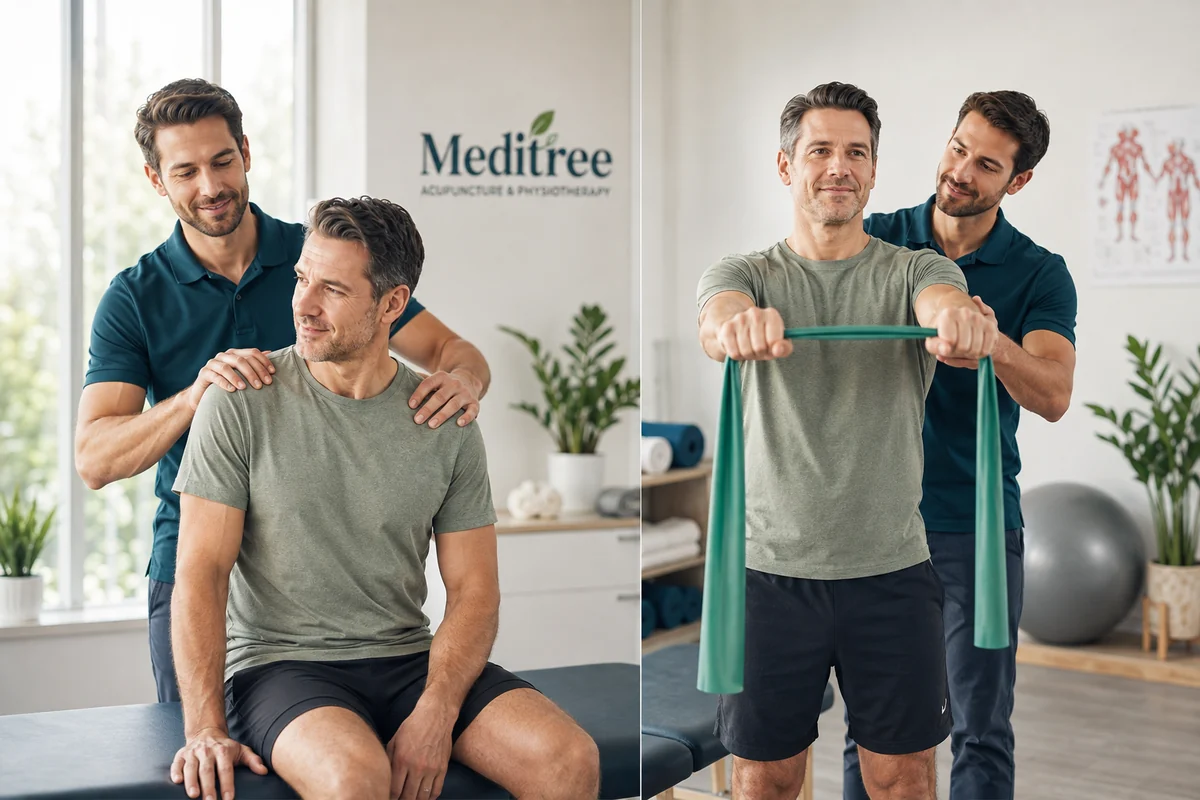
Pain management approaches, including acupuncture and manual treatment, may be considered when pain significantly limits movement and daily activities.
Depending on the assessment and the individual, treatment may be used to help manage current pain and muscle tension, support more comfortable movement and create a suitable starting point for rehabilitation.
For example, symptom management may need to come first when shoulder pain makes it difficult to lift the arm, knee pain limits walking, or neck and back pain disrupt sleep.
However, pain management alone may not fully restore strength, balance, joint control, movement habits or the physical capacity required for work and sport. Once movement becomes more manageable, rehabilitation may still be needed to rebuild function.
The role of exercise rehabilitation
Exercise has a different role from symptom management. A rehabilitation programme tailored to the individual may support the recovery of strength, joint range, balance, movement control and the ability to perform daily activities.
The goal is not to do as much exercise as possible. The goal is to start at a level the body can manage and progress appropriately.
When exercise is too difficult or intense for the current stage of recovery, the body may compensate by moving differently to protect the painful area. Exercise should therefore be adjusted to the individual and progressed according to their response.
Rather than asking which option is better, it is more useful to ask which approach is appropriate for the current stage of recovery.
Treatment and exercise are not competing options
Treatment and exercise are not opposing choices. They can serve different purposes during recovery.
The same order does not apply to everyone. When pain makes movement very difficult, symptom management may come first. When pain is more stable and movement is safe, exercise may begin from the start.
| Pain management treatment | Exercise rehabilitation |
|---|---|
| May help manage current symptoms | Supports strength and functional recovery |
| May help movement feel more comfortable | Improves movement control and physical capacity |
| Can create a starting point for rehabilitation | Prepares for daily activity, work and sport |
| May be considered first when pain is severe | May begin early or after symptoms settle |
Pain reduces → normal activity resumes → the same load is repeated → symptoms return
What can be missed when treatment is repeated without rehabilitation?
A reduction in pain is a positive change. However, if strength, joint movement, balance and activity habits have not recovered, similar loads may affect the same area again after returning to normal activity.
This does not necessarily mean the earlier treatment failed. It may mean that the functional recovery stage still needs attention.
What happens when exercise progresses too quickly?
When exercise is pushed too hard while pain is severe, the body may change the way it moves to protect the painful area.
Examples may include:
- Limping because of knee pain
- Using the neck and upper back to compensate for shoulder movement
- Reducing hip movement because of back pain
- Changes in balance and walking after an ankle injury
These are often described as compensatory movements. If they continue, they may increase unnecessary load on other areas. The aim is not to avoid movement, but to select an appropriate exercise and intensity for the current stage.
How does Meditree plan recovery?
Meditree does not apply the same fixed order of treatment and exercise to every patient. We consider pain, movement, joint range, strength, balance, daily limitations and personal recovery goals before deciding on an appropriate starting point.
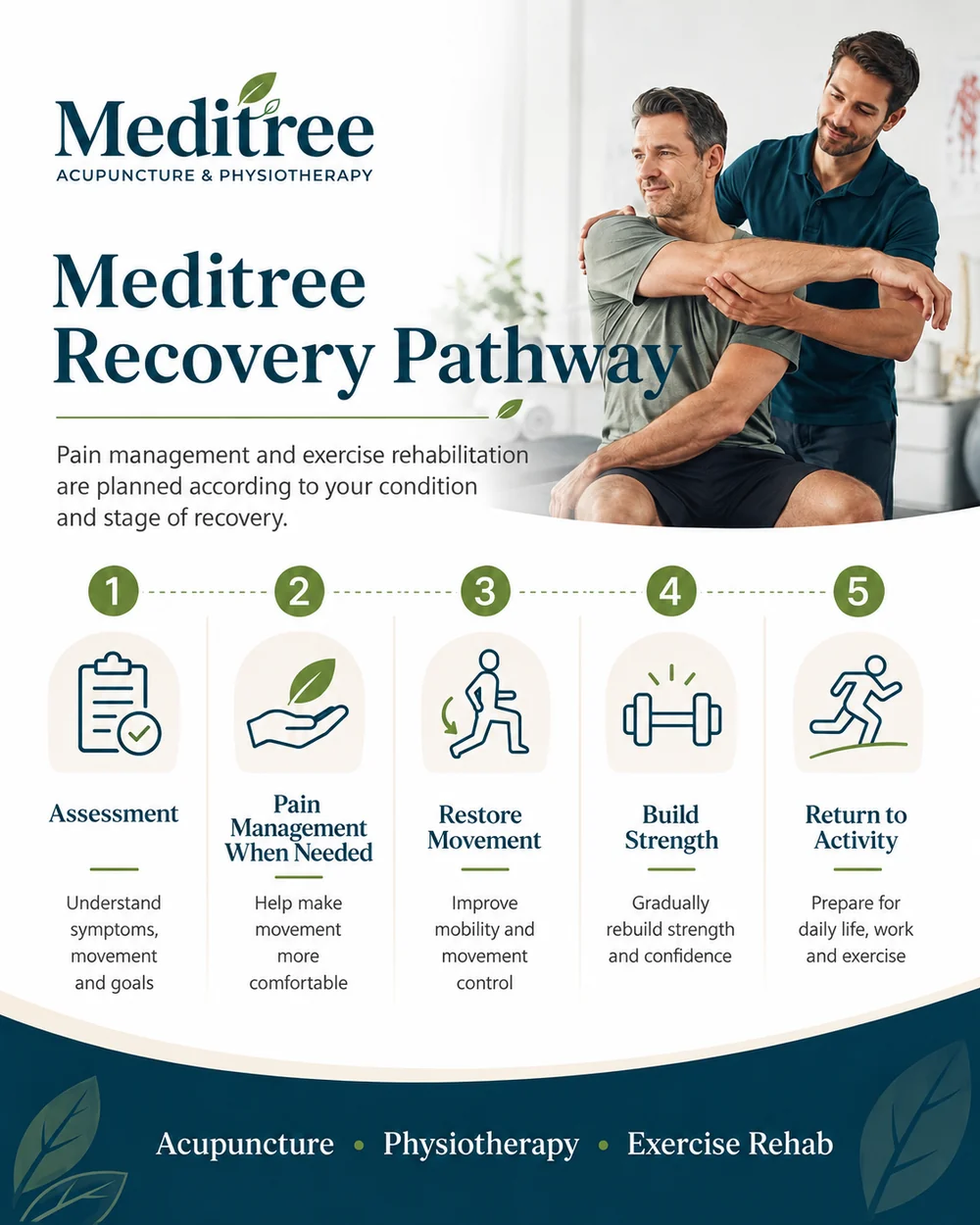
Step 1: Assessment
The assessment may include:
- Location and severity of pain
- When symptoms began and how they have changed
- Joint movement and flexibility
- Strength and balance
- Daily tasks such as walking, sitting and lifting
- Physical demands of work or sport
- The activities the patient wants to return to
Step 2: Pain management when needed
Depending on the assessment, options may include acupuncture, manual treatment, gentle movement, activity modification, home-care advice or collaboration with another healthcare professional.
The purpose of this stage is not to rely on repeated treatment indefinitely. It is to create a suitable foundation for safe movement and rehabilitation.
Step 3: Rebuilding movement and function
As symptoms become more manageable, rehabilitation may include joint range exercises, strengthening, balance training, movement retraining, functional exercises and a gradual return to activity.
Comfortable movement → basic movement control → light strengthening → increased load → return to daily activity, work or sport
What is progressive loading?
Progressive loading does not mean starting with heavy or difficult exercise. It means beginning at a level the body can manage and gradually increasing the challenge while monitoring pain and movement response.
The rate of progression may depend on pain response, strength, joint range, balance, daily demands and work or sporting goals.
What role can acupuncture play in recovery?
At Meditree, acupuncture may be considered as one option within pain management.
Depending on the assessment, acupuncture may help some patients manage pain and muscle tension and move more comfortably.
However, when strength, balance or movement control have declined, acupuncture alone does not automatically rebuild these abilities.
- Acupuncture may support a more comfortable start to movement.
- Exercise supports strength and functional recovery.
- Progressive rehabilitation prepares the body for everyday and higher-level activity.
When should assessment come before exercise?
Seek assessment before progressing exercise when there is:
- A sudden or significant increase in pain
- New numbness or altered sensation
- New weakness
- Pain that significantly disrupts sleep
- Major difficulty walking or completing daily activities
- Pain that began after a fall, accident or injury
- Symptoms that continue to worsen unexpectedly
These signs do not always indicate a serious problem, but they can be important when deciding on a safe treatment and exercise plan.
Manage today's pain and prepare for tomorrow's movement
Meditree Acupuncture & Physiotherapy aims to look beyond short-term symptom relief.
We consider pain, movement, joint range, strength and daily function, then develop a treatment and rehabilitation plan that reflects the patient's current stage and goals.
Some patients may need pain management first. Others may begin exercise and rehabilitation immediately. In many cases, the two approaches can be used together at the appropriate time.
For assessment, acupuncture, physiotherapy or exercise rehabilitation in East Tamaki, contact Meditree.
Pain treatment can make today's movement more comfortable. Rehabilitation helps prepare for tomorrow's activity.
Frequently asked questions
Should I exercise when I have pain?
Exercise does not always need to stop completely, but the type and intensity should match the current symptoms and assessment. When pain is severe or accompanied by new numbness or weakness, assessment should come first.
Can I exercise immediately after acupuncture?
This depends on the individual and their response to treatment. Gentle movement or prescribed exercises may be appropriate, while strenuous or unfamiliar exercise should be discussed with the practitioner.
Do I still need rehabilitation when the pain has improved?
Possibly. Pain may improve before strength, joint movement and daily function have fully recovered. Rehabilitation may still be recommended depending on the assessment.
Do treatment and exercise always need to be combined?
No. Some people need pain management first, while others can begin exercise immediately. The combination and order depend on the individual's symptoms and goals.
How much exercise should I do?
The amount and intensity depend on symptoms, strength and the stage of recovery. A small number of appropriate exercises performed well may be more useful than attempting many exercises at once.
Health information notice
This article provides general health information and does not replace individual diagnosis or treatment. Causes of symptoms and appropriate treatment or exercise plans vary between individuals. Consult a qualified healthcare professional for advice that reflects your specific condition.
Written by: Meditree Clinical Team
Meditree Acupuncture & Physiotherapy
East Auckland
Related treatments
Learn more about the services discussed in this article.
Related conditions
Explore condition-specific information that may relate to this article.
Book a consultation
If you would like personalised advice, our team can help you decide whether acupuncture, physiotherapy, herbal medicine or ACC-supported care may be suitable.
Related articles
Continue reading with related health articles from Meditree.
Acupuncture vs Physiotherapy: Which Is Right For You?
Understand how acupuncture and physiotherapy differ, and when an integrated approach may support pain or injury recovery.
Read moreLower Back Pain Treatment in East Auckland: Physiotherapy, Acupuncture and ACC Support
Struggling with lower back pain? Learn the common causes, treatment options, physiotherapy, acupuncture and ACC support available in East Auckland.
Read moreKnee Pain Treatment in East Auckland: Physiotherapy, Acupuncture and ACC Support
Learn the common causes of knee pain, treatment options, physiotherapy, acupuncture and ACC rehabilitation available in East Auckland.
Read moreCommon Sports Injuries and Recovery Options
Explore common sports injuries and how physiotherapy, acupuncture and rehabilitation can support recovery in East Auckland.
Read more